
Driveway aprons and culverts in Citrus County: what the county code asks for
By Citrus County Concrete · Published · Updated
Short answer: The apron is the stretch of driveway between the edge of a county road and your property line. Citrus County requires a driveway apron permit for a new home, a replacement home, or any new access onto a county road, and a residential apron has to be at least 12 feet wide at the property line and no wider than 24 feet without extra stormwater work on the lot and County Engineer approval. If the drive crosses a roadside swale, a culvert may have to go under it so the swale keeps draining.
Fixing an apron that was already permitted does not need a new permit. Making it wider, or changing how water runs along the road, does. The quotes on this page come from the county's Land Development Code, its Building Division inspection guide, and FDOT.
What is a driveway apron, and why does the county care?
The apron sits on public right-of-way, not on your lot. Section 7900 of the county's Transportation System Standards says that, unless the land makes it impossible, every apron must be "located and constructed within the right of way," connected to both the road and the driveway, "positioned as nearly perpendicular to the roadway as possible," and built to "provide for stormwater flow as shown on the approved apron plan."
That last condition is the reason aprons get reviewed at all. A slab dropped across a roadside swale without a plan can block the water the swale was dug to carry and push it back onto the lot upstream.
When does an apron need a permit?
Under Section 7900, properties that access County roadways need a driveway apron permit for:
- New residential and nonresidential development.
- Replacement residential homes.
- New access to a property, vacant or built on, that abuts a County roadway.
Existing accesses that already meet the section do not need a permit. The code adds that "repairs and improvements to existing permitted access will not require new permits; however, modification to the roadside drainage pattern or widening of the existing access shall require a permit." Replacing a cracked apron at the same width, with no change to drainage, fits that repair language. Widening a single-car apron for a second lane needs a permit.
What if the road is not a county road?
Section 7900 is written for County roadways. On a state highway such as US 19 or SR 44, the connection belongs to the Florida Department of Transportation. FDOT's rule says: "No person may construct, relocate, or alter a connection temporarily or permanently without first obtaining a connection permit from the Department, as provided in this rule chapter, regardless of governmental entity permits and approvals." FDOT takes driveway applications through its One Stop Permitting site.
Inverness and Crystal River are incorporated cities. If your lot is inside either city, start with that city's permitting office, such as Inverness Community Development, before relying on the county rules here.
Sources: FDOT Access Management, FDOT Multimodal Access Management Guidebook (citing Rule 14-96.003, F.A.C.).
How wide can a residential apron be, and where can it go?
The residential limits in Section 7900 are specific:
- Width at the property line is 12 feet minimum and 24 feet maximum. Going wider than 24 feet requires "construction of additional stormwater runoff compensation on the property" and approval from the County Engineer or his representative.
- Each apron needs "a minimum return radius of 15 feet or four-foot flares" where it meets the road.
- An apron has to be at least 50 feet from the edge of pavement of an intersecting road.
- A tract with 50 feet of frontage or less gets one apron. No single residential property gets more than two.
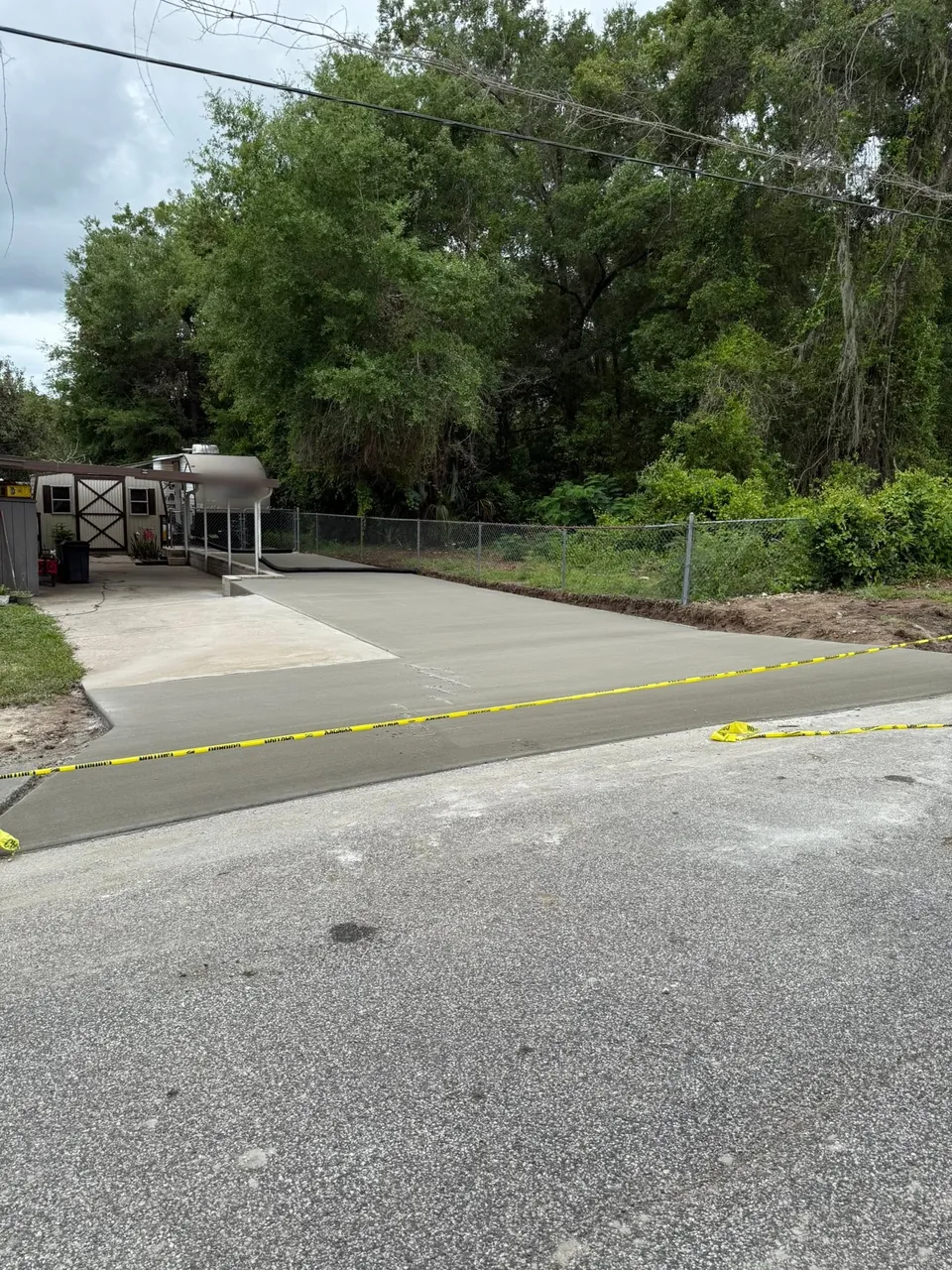
A flare is the angled section where the apron widens at the road, so a turning car stays on concrete. One shows at the left edge of the photo at the top of this page.
Does my driveway need a culvert?
It depends on whether the drive crosses a swale. Chapter Six of the code, on stormwater, says: "Driveways across roadside swales may require the placement of a drainage culvert under the driveway in order not to impede flow in the swale resulting in an increase of backwater onto upstream property." The same section says the culvert size is noted on the improvement plans for each buildable lot, and that removing or changing an existing side drain "is not allowed without prior County approval by the Department of Public Works."
If a pipe is already under your old driveway, leave it where it is unless the county has approved a change.
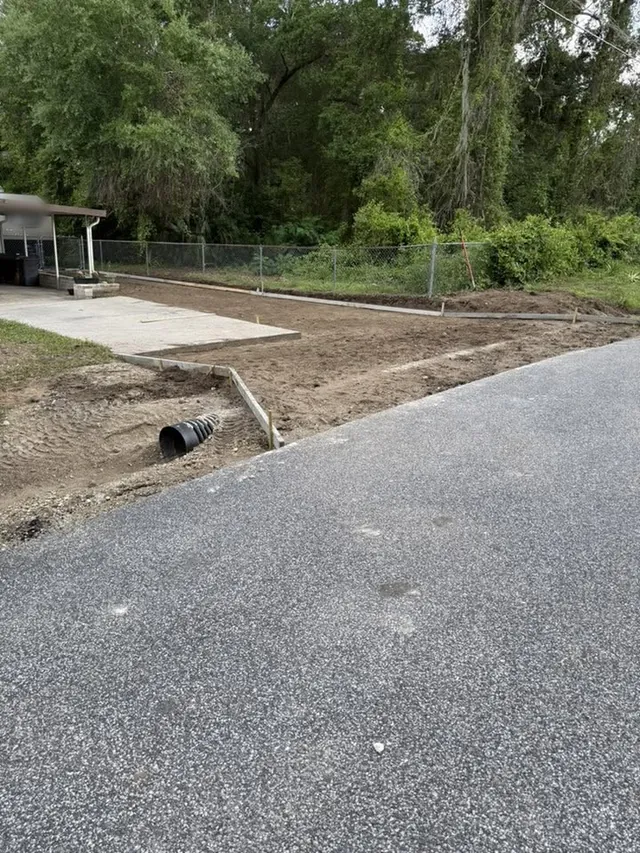
On the Inverness job below, the pipe is already set in the low point of the swale and the wood forms are staked along the asphalt edge, angling out where the apron widens. The sand inside the forms is graded smooth. The photo at the top of this page shows the same driveway after the pour.
How are the culvert ends finished?
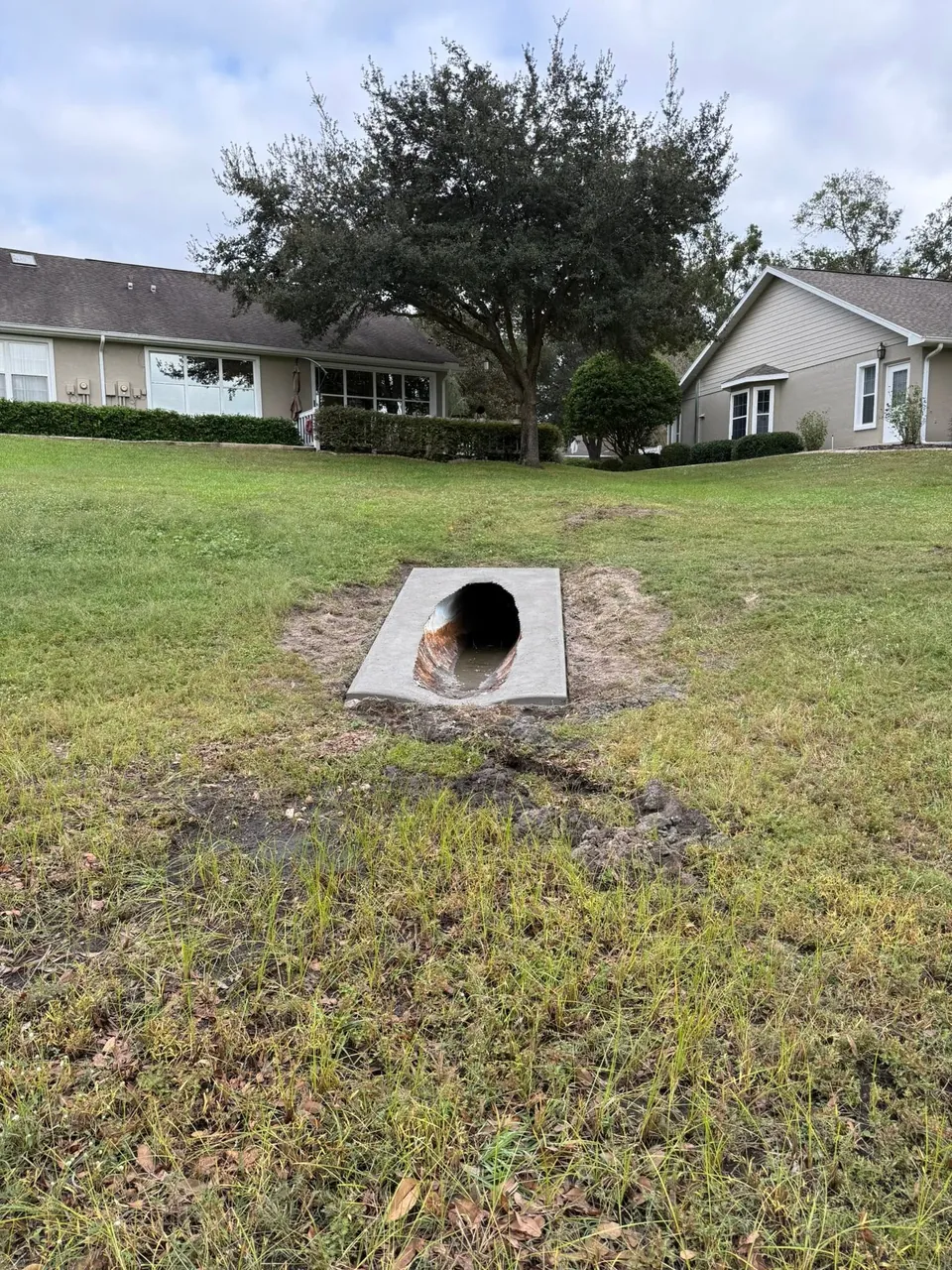
A note on the apron detail in Chapter Seven says culvert pipe "shall be fabricated with mitered ends in accordance with FDOT standards." The culvert section of the same chapter says cover material over culverts in swales "shall be stabilized, compacted, and sodded to prevent erosion." A mitered end is cut at an angle to follow the slope of the swale instead of sticking straight out of the bank.
Setting a culvert means digging, so the Sunshine 811 call comes first. Our site prep guide covers the two-business-day notice rule.
Source: Citrus County LDC, Chapter Seven, Sections 7660 and 7900.
What does the county want the apron made of?
Section 7900 says the apron "shall be constructed to meet or exceed abutting roadway improvements." For concrete, the sidewalk standards in Section 7671 set 3,000 psi concrete and a standard thickness of four inches, "except for driveways, where the minimum thickness shall be six (6) inches with welded wire fabric." The next paragraph adds: "Driveway aprons shall also include six (6) inch by six (6) inch #10 wire mesh reinforcement or an equivalent support such as fiber mesh."
Section 7900 refers to an approved apron plan, so get a copy and read it before the forms go in.
Can the apron be stamped or colored?
Yes. Section 7900 says aprons built to county standards "may have special surface designs or coloring at the sole expense of the owner." There is one catch. If the county, or a utility working under a county permit, cuts out part of the apron, it only has to put it back to county standards. Restoring the pattern or color is on the owner.
If you want the apron to match a stamped concrete driveway, the code allows it. Just plan on the chance that a utility repair later leaves a plain patch.
Who maintains the apron, and when is it inspected?
The owner does. Section 7900 says work on an apron "for the sole benefit of the property owner" is at the owner's expense, and that aprons "shall be maintained by the property owner in such a manner so as not to create a hazard." The county keeps the right to rebuild or replace an apron at no cost to the owner when it decides road or drainage work is needed.
On a new home, the Building Division's inspection guide lists a Final Driveway Apron inspection, "applicable if the structure's driveway connects to a public roadway," done by the Road Maintenance Division. Section 7900 sets the deadline: for residential properties, the apron has to be built and inspected "within 30 days of the issuance of a Certificate of Occupancy." Any damage to the right-of-way from the apron work has to be repaired before final release.
Before the apron is formed
- Find out who owns the road: the county, a city, or FDOT.
- Measure the frontage and the distance to the nearest intersecting road.
- Look for a swale or an existing pipe along the road edge.
- Decide the width at the property line, keeping in mind the 12 to 24 foot range.
- Pick the finish: broom or stamped.
The concrete driveways page covers the rest of the drive, from tear-out to finish. The project gallery includes a finished culvert and apron job. To have someone measure your frontage and look at the swale, request a free estimate.